
What Size Air Compressor Do I Need for a Tire Repair Shop?
What Size Air Compressor Do I Need for a Tire Repair Shop?
If you are setting up a new tire repair shop or upgrading your auto garage, choosing the right air compressor is the most critical decision you will make. Buy one that is too small, and your impact wrenches will stall. Buy one that is unnecessarily large, and you waste money on electricity and maintenance.
So, what’s the quick answer? For a standard, two-bay tire repair shop, you typically need a two-stage air compressor with a 60-to-80-gallon tank, a 5-to-7.5 HP motor, delivering at least 14 to 20 CFM at 90 PSI.
But every shop is different. From our years of experience supplying automotive equipment, here is exactly how you should calculate your shop's true compressed air needs.
Stop Looking at Gallons. Start Looking at CFM.
The biggest mistake shop owners make is buying a compressor based purely on the tank size (gallons). The Compressed Air and Gas Institute (CAGI) advises that the most important metric for any pneumatic tool operation is CFM (Cubic Feet per Minute).
CFM measures the volume of air the compressor can deliver. If your tools require more CFM than the pump can produce, the tank will drain quickly, pressure will drop, and your mechanics will be standing around waiting for the compressor to catch up.
Calculate the Air Consumption of Your Tire Shop Tools
To find the right size, you need to add up the CFM of all the tools that might be used at the exact same time. Here is a real-world breakdown of typical tire shop equipment:
| Pneumatic Equipment | Average CFM Required (@ 90 PSI) |
| 1/2" Impact Wrench (Lug nuts) | 4 - 5 CFM |
| 1" Heavy-Duty Impact (Truck tires) | 10 - 12 CFM |
| Tire Changer Machine | 3 - 5 CFM |
| Pneumatic Tire Vulcanizing Machine | 2 - 4 CFM |
| Tire Inflation Hose | 1 - 2 CFM |
| Air Die Grinder (For buffing tires) | 4 - 6 CFM |
The Calculation Formula:
Let's say your shop has two mechanics working simultaneously. One is using a 1/2" impact wrench (5 CFM) while the other is operating a pneumatic tire vulcanizing machine (4 CFM).
Your total simultaneous use is 9 CFM.
The Golden Rule: Always multiply your total simultaneous CFM by 1.25 (a 25% safety margin) to account for system leaks and future expansion.
9 CFM x 1.25 = 11.25 CFM. You need a compressor that delivers at least 11.25 CFM at 90 PSI.
Tank Size (Gallons) and Pressure (PSI)
While CFM is king, tank size matters for burst energy.
- Why 60 to 80 Gallons?Tools like impact wrenches require short, massive bursts of air. A larger tank acts as a buffer, ensuring the air pressure doesn't immediately drop when you pull the trigger.
- PSI (Pounds per Square Inch):Most tire shop tools operate perfectly at 90 to 120 PSI. A standard two-stage compressor will easily compress air up to 175 PSI, storing plenty of dense air in the tank.
Single-Stage vs. Two-Stage Compressors
For any commercial tire repair shop, do not buy a single-stage compressor.
You need a Two-Stage Compressor. These machines compress the air once, cool it, and then compress it a second time. This delivers higher pressure (up to 175 PSI), runs cooler, and generates far less moisture in your airlines—which is critical because water ruins air tools and compromises tire patches.
The Bottom Line for Auto Shops
Don't let undersized equipment slow down your daily operations. A reliable, heavy-duty air supply is the heartbeat of your garage.
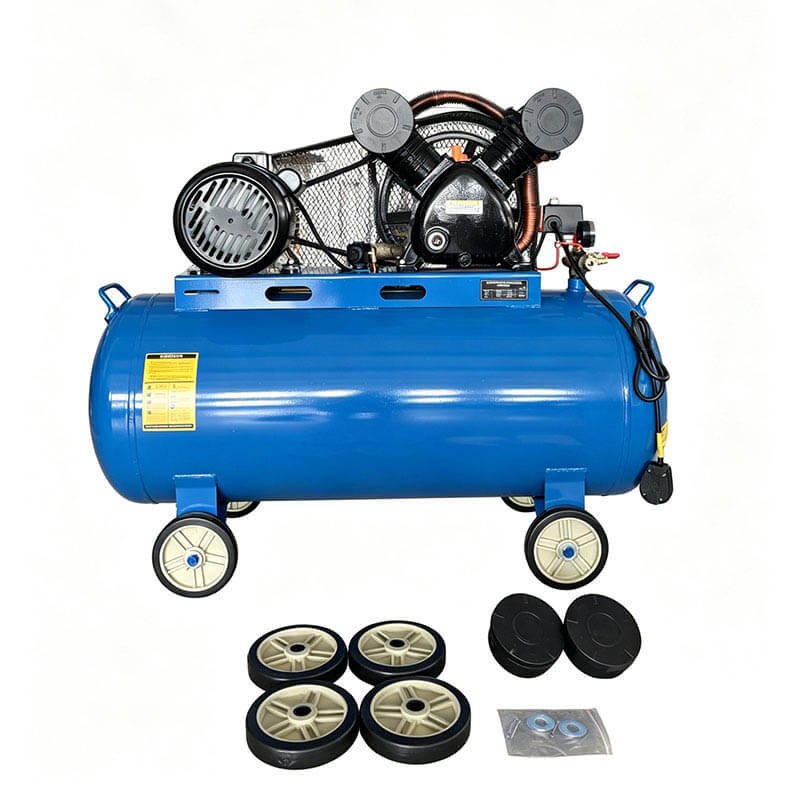
If you are looking for equipment built to withstand the demands of a busy tire shop, check out our specially selected Industrial Air Compressors, designed to perfectly power everything from your heavy-duty impact wrenches to our professional tire vulcanizers.
Conclusion – Optimize Your Tire Shop Workflow
Investing in the right-sized air compressor saves time, reduces downtime, and increases shop efficiency. Consider pressure, airflow, tank capacity, and duty cycle before purchasing. Whether running a small workshop or a high-volume tire repair center, a properly selected compressor ensures professional performance every day.
(Need help sizing your equipment or looking for bulk auto repair supplies? Contact our engineering team] today for a free consultation.
Ready to Upgrade Your Auto Parts Inventory?
Whether you need high-volume Air Compressor , we have the manufacturing capacity to meet your demands. Let's build a profitable partnership today.
FAQ – Air Compressor Selection for Tire Shops
Q1: Can a small 24L tank compressor handle multiple cars at the same time?
A: No, smaller tanks are ideal for single-car service. For multi-bay operations, choose a larger tank with higher CFM.
Q2: How often should I maintain my compressor?
A: Drain the tank daily, check oil levels weekly (for oil-lubricated models), and clean filters monthly.
Q3: Is 220V necessary for a medium shop?
A: Yes, 220V motors provide higher power output and support continuous duty in busy shops.
Q4: Can I use the same compressor for pneumatic tools?
A: Absolutely, ensure your CFM rating meets the tool’s requirement to avoid performance drops.