
How to use jack stands
Using a car jack and jack stands (typically safety stands/maintenance stands) is the most crucial safety procedure when performing tasks such as vehicle undercarriage repair or tire replacement. Incorrect use can lead to the vehicle collapsing, causing serious personal injury or property damage.
Core Safety Principles:
- A jack is only for lifting a vehicle, and must never be used as a long-term support device. After lifting, safety stands must be immediately placed at the designated support points of the vehicle before anyone can work under the vehicle.
- Never work under a vehicle supported solely by a jack.
- Choose a firm, flat, and level surface (such as concrete), and never operate on soft or sloping ground.
Required Tools:
Car Jack: Either the jack included with the vehicle (less efficient, only recommended for emergency tire changes) or a more stable hydraulic floor jack/vertical pneumatic jack.
Safety Stands (Jack Stands): At least two, with a weight capacity greater than the vehicle's weight.
Wheel Chock: Used to secure the wheels that are not being lifted.
Gloves and safety glasses.
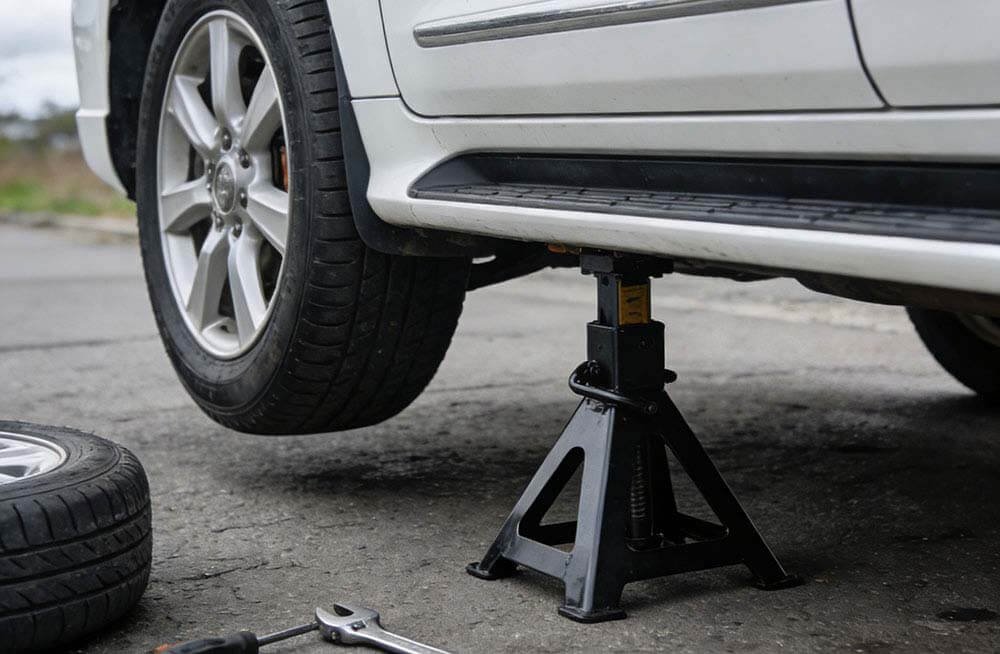
Operating steps
Phase 1: Preparation
-
Park the vehicle and set up warning signals: Park the vehicle on a firm, level surface, engage the handbrake, and put the transmission in park (or first gear or reverse for manual transmissions). Turn on the hazard lights and place a warning triangle at an appropriate distance behind the vehicle.
-
Wheel Chock: Securely block the wheel diagonally opposite to the wheel being worked on using wheel chocks. For example, to lift the left front wheel, block the right rear wheel. If lifting the entire front or rear of the vehicle, block all wheels that are not being lifted.
-
Find a point of support.:
-
Jack lifting point:Consult your vehicle's owner's manual to locate the metal protrusions or reinforced areas specifically designed for the jack (usually on the side sills below the doors). Never place the jack on the fuel tank, suspension components, underbody panels, or plastic parts.
-
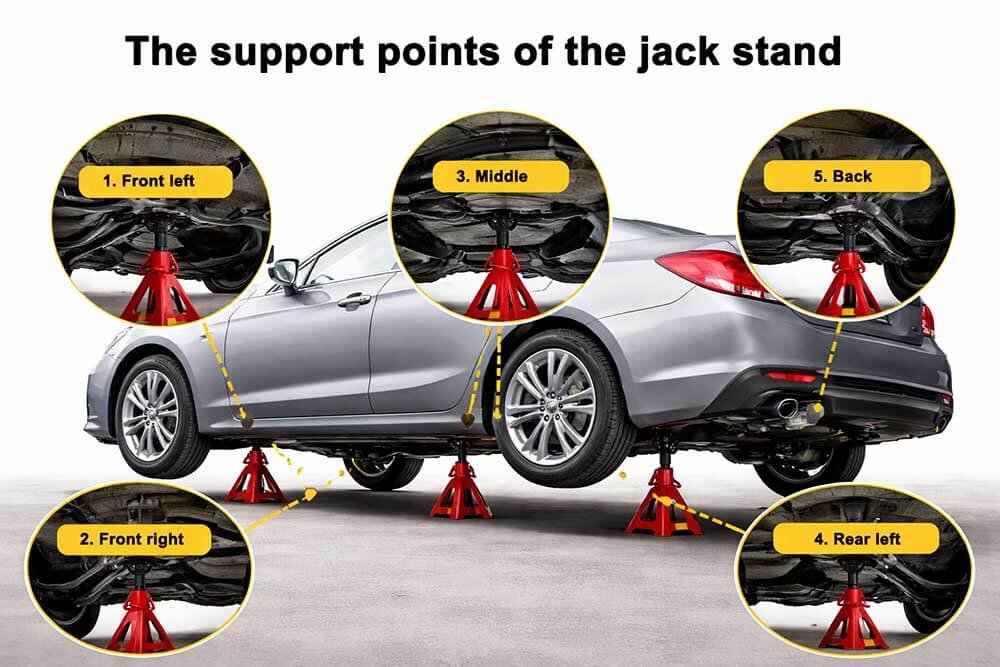
Safety support points: Refer to the user manual to find more stable support points on the chassis, usually the designated welding points or reinforced areas on the frame rails or subframe. These points are located further inward than the jack points and can withstand greater weight.
-
-
Prepare the tools: Place the car jack and jack stands next to the vehicle, ready for use.
Phase two: Lifting the vehicle
- Initial lifting: Position the auto jack at the designated jacking point, operate it smoothly, and lift the vehicle until the tire is just off the ground. Pause and check if the jack base is stable and if the jack head is properly positioned.
- Fully lift the vehicle: After confirming everything is correct, continue operating the jack to lift the vehicle 5-10 centimeters higher than the required working height, leaving space for placing the jack stands.
Phase 3: Installing the safety support structure (the most crucial step)
- Placing the support jack stands: Align the two safety support stands with the "safety support points" and place them on both sides of the vehicle. Ensure that the base of each stand is in full contact with the ground and that the top support plate makes good contact with the metal parts of the vehicle.
- Adjust the height: Rotate the adjustment screw on the support bracket until it just touches the support point, ensuring it is vertical and not tilted.
- Slowly release the auto jack: Operate the jack in reverse very slowly, allowing the vehicle's weight to gradually and smoothly transfer onto the two safety stands. You will feel the stands begin to bear the load.
- Confirming support: Once the vehicle's weight is fully supported by the safety stands, the jack will be in a "no-load" state. At this point, forcefully shake the vehicle to check for stability. The locking pins of the safety stands must be fully inserted. The jack can remain in place as an extra safety backup, but it should never be relied upon.
Phase 4: Assignments and Finalization
- Starting the work: Ensure the vehicle is stable before beginning any repair work.
- Lifting the vehicle again after completion: After the work is finished, use the jack to slightly lift the vehicle again so that the safety stands are just barely relieved of the load.
- Removing the stands: Lower the adjustment screws on the safety stands and remove the stands.
- Slowly lowering the vehicle: Finally, operate the jack very slowly to lower the vehicle smoothly to the ground. Remove the jack.
Important Precautions and Prohibitions
- Do not lie under a lifted vehicle unless it is reliably supported by safety stands.
- Do not overload: Ensure that the rated load capacity of the jack and safety stands is greater than the vehicle weight.
- Do not use unstable blocks: If additional height is needed, use professional, sturdy blocks; never use fragile items such as bricks, wood, or concrete blocks.
- Do not shake or apply lateral force to a lifted vehicle.
- Exercise extra caution in windy conditions.
- Vehicle-supplied jacks: These are designed only for emergency tire changes. After lifting the vehicle, change the tire as quickly as possible and lower the vehicle immediately. Their stability and safety are far inferior to a professional jack and stand combination.
The support points of the jack stand
 |
How To Use Jack Stands |
Jack Stands FAQ
1. How to use jack stands safely?
Answer:
To use jack stands safely, first lift the vehicle with a hydraulic or electric jack on a flat, solid surface. Place the jack stands under the manufacturer-recommended support points, then slowly lower the vehicle onto the stands. Always engage the locking mechanism and never work under a car supported by a jack alone.
2. Where should jack stands be placed under a car?
Answer:
Jack stands should be placed at the vehicle’s designated support points, such as the pinch welds, frame rails, or reinforced areas specified in the owner’s manual. These points are designed to support the vehicle’s weight safely. Never place jack stands under the oil pan, exhaust system, or plastic body panels.
3. Are jack stands safer than a hydraulic jack?
Answer:
Yes, jack stands are safer than a hydraulic jack for supporting a vehicle. A jack is designed to lift a car, not to hold it for extended periods. Jack stands provide stable, mechanical support and significantly reduce the risk of sudden vehicle collapse during maintenance or repairs.
4. Is it safe to work under a car supported only by a jack?
Answer:
No, it is not safe to work under a car supported only by a jack. Hydraulic and electric jacks can fail due to leaks, mechanical issues, or instability. Jack stands are essential because they provide a solid, locked support that protects against sudden drops while working under the vehicle.
5. Why are jack stands necessary for car repairs?
Answer:
Jack stands are necessary because they securely support the vehicle’s weight during repairs. They prevent accidental lowering or collapse that can occur when relying on a jack alone. Using jack stands greatly improves safety when performing tire changes, brake work, or under-car inspections.
6. What are the correct jack stand support points?
Answer:
Correct jack stand support points include reinforced pinch welds, frame rails, subframes, or axle housings, depending on the vehicle type. These points are engineered to handle the vehicle’s weight. Always refer to the owner’s manual to identify the correct support locations before positioning jack stands.
7. How much weight can jack stands support?
Answer:
Jack stands are rated by capacity, such as 2-ton, 3-ton, or higher. The rating usually applies to a pair of stands, not a single stand. Always choose jack stands with a weight rating higher than your vehicle’s total weight to ensure safe and stable support.
8. Can jack stands be used on uneven ground?
Answer:
Jack stands should not be used on uneven or soft ground. An unstable surface can cause the stands to shift or tip over. For safe use, always place jack stands on a flat, solid surface such as concrete, and avoid gravel, dirt, or sloped areas.
9. Should wheels be chocked when using jack stands?
Answer:
Yes, wheels should always be chocked when using jack stands. Wheel chocks prevent the vehicle from rolling while it is lifted and supported. This added safety step is especially important when working on sloped surfaces or when only one end of the vehicle is raised.
10. What happens if you don’t use jack stands?
Answer:
If jack stands are not used, the vehicle may suddenly drop if the jack fails or shifts. This can cause serious injury, vehicle damage, or death. Jack stands are a critical safety tool that provides reliable support and significantly reduces the risk during vehicle maintenance.