


TW303 RV Tire Pressure Monitoring System
The TW303 RV Tire Pressure Monitoring System, repeater and receiver to detect the air pressure and temperature in the tire in real time. After collecting the pressure and temperature data in the tire, the sensor is sent to the repeater in the form of radio frequency, which is then sent by the repeater to the receiver, received and processed by the receiver and displayed on the display screen. When the pressure or temperature in the tire is higher or lower than the preset alarm threshold, the receiver will automatically complete the corresponding alarm to alert the user to the state of the tire. Through the operation of this system, it can improve the comfort of the vehicle, prevent tire burst, reduce fuel consumption, reduce tire wear and indirectly improve the power performance.
Applicable models
Trucks that meet the following three conditions simultaneously can be used:
1. The tire pressure is within 13Bar;
2. The number of 26 wheels below;
3. Vacuum tire.
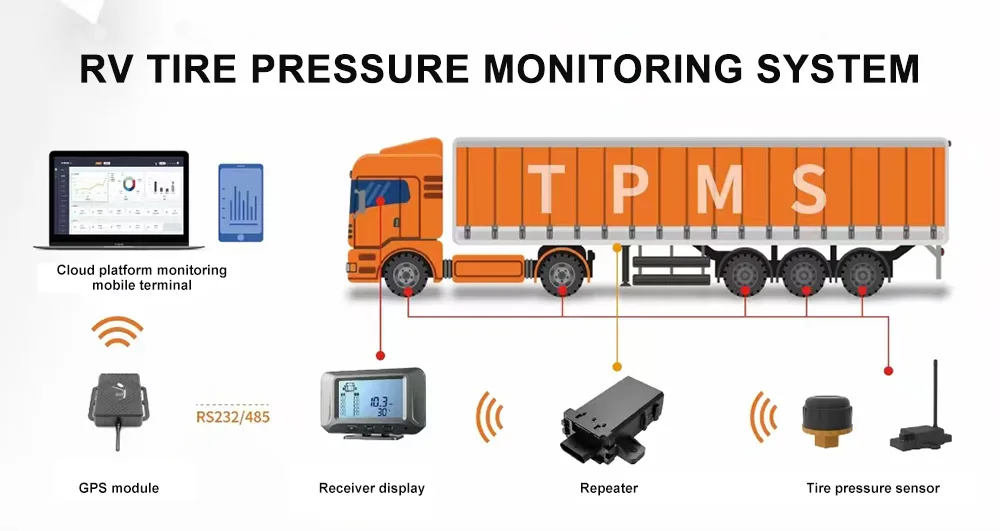

Product technical parameters
Monitor
| Order number | Project | Technical Parameter |
| 1 | External input voltage | DC 9V~DC 36V |
| 2 | Complete machine working current | ﹤15 mA |
| 3 | System operating current (24V) | ﹤50 mA |
| 4 | High frequency reception frequency | 433.92 MHz±38 KHz |
| 5 | High-frequency reception sensitivity | <-105 dBm |
| 6 | working temperature | -30℃-80℃ |
| 7 | storage temperature | -40℃-125℃ |
External sensor
| Order number | Project | Technical Parameter |
| 1 | Battery model | CR1632(140mAh) |
| 2 | RF frequency | 433.92 MHz±38 KHz |
| 3 | Standby current | ﹤0.7 uA |
| 4 | Emission current | ﹤10 mA |
| 5 | High frequency emission power | ﹤5 dbm(50Ω) |
| 6 | High frequency modulation mode | FSK |
| 7 | Low frequency reception frequency | 125 KHz±5 KHz |
| 8 | Low frequency demodulation method | ASK |
| 9 | Pressure measurement range | 0-13 bar |
| 10 | Pressure resolution | 2.75 KPa |
| 11 | Pressure measurement accuracy | ±0.2 bar(0℃~40℃) |
| ±0.3 bar(-20℃~50℃) | ||
| ±0.48 bar(-30℃~60℃) | ||
| 12 | Temperature measurement range | -30℃~60℃ |
| 13 | temperature resolution | 1℃ |
| 14 | Temperature measurement accuracy | ±3℃(0℃~60℃) |
| 15 | Operating temperature range | -30℃~60℃ |
| 16 | Storage temperature range | -30℃~60℃(Storage at room temperature) |
| 17 | Levels of protection | IP67 |
| 18 | Battery life | More than 1 year |
Repeater
| Order number | Project | Technical Parameter |
| 1 | working voltage: | DC 9 V ~ 36 V |
| 2 | RF signal transmitting center frequency: | 433.92 MHz |
| 3 | RF emission signal modulation mode: | FSK |
| 4 | RF emission signal encoding mode: | Manchester |
| 5 | RF emission signal wave rate: | 5K bps |
| 6 | RF signal transmitting power: | ﹤ 10 dbm |
| 7 | RF signal reception sensitivity: | ﹤-105 dbm |
| 8 | Maximum operating current: | ﹤ 50 mA |
| 9 | Frequency of the RF signal receiving center: | 433.92 MHz |
| 10 | working temperature: | -40℃ ~ 85℃ |
Product function characteristics
Monitor
- LCD screen displays pressure and temperature
- Custom tire arrangement method, capable of synchronously monitoring 18 tire pressures
- GPS backend monitoring of tire pressure
- Tire high/low pressure alarm standard values can be set
- LCD display and sound prompt alarm when pressure and temperature are abnormal
- Multiple options for pressure/temperature units
- Can display pressure and temperature simultaneously
- Loop display of all tire information
- Long receiving distance
External sensor
- The high-frequency transmission method uses FSK modulation signal, and the low-frequency transmission method uses ASK modulation signal
- Vehicle grade materials with long lifespan, high stability, and strong anti-interference ability
- Simultaneously measure and monitor air pressure and temperature, and have self checking and tire leak monitoring functions
- Adopting IP67 protection level
- Light weight, small size, easy installation
Repeater
- Transfer data, data transmission between sensors and receivers
- Increase the signal strength when the distance is far and the signal weakens to ensure the reliability of the transferred signal reception
- Full thread fixed mode, using IPX6 waterproof testing standard
- Internally integrated high-frequency transmission and reception functions, high-sensitivity data reception
 Contact Us
FAQ About Tire Pressure Monitoring Systems (TPMS)
What is a Tire Pressure Monitoring System (TPMS)?
A Tire Pressure Monitoring System (TPMS) is an electronic system that monitors the air pressure inside vehicle tires. Sensors installed in each wheel detect pressure changes and send data to the vehicle dashboard. When tire pressure is too low, the system alerts the driver to improve safety and prevent tire damage.
How Does a Tire Pressure Monitoring System Work?
A TPMS works by using sensors installed in the tire or valve stem. These sensors measure tire pressure and transmit data wirelessly to the vehicle’s control unit. If the pressure drops below the recommended level, the system triggers a warning light to alert the driver.
Why Do Trucks Need TPMS?
Trucks require TPMS because they carry heavy loads and travel long distances. A truck tire pressure monitoring system helps prevent tire blowouts, improves fuel efficiency, and reduces tire wear. For fleet vehicles, TPMS also helps monitor tire conditions and reduce maintenance costs.
How to Replace a TPMS Sensor?
To replace a TPMS sensor, the tire must first be removed from the wheel rim. The old sensor attached to the valve stem is then replaced with a new one. After installation, the tire is remounted and the new sensor is programmed or relearned using a TPMS tool.
How to Install a TPMS Valve Stem?
Installing a TPMS valve stem involves inserting the valve through the wheel rim, attaching the sensor inside the rim, and tightening the retaining nut to the recommended torque. After mounting the tire, the system should be checked and programmed if required.
Are TPMS Sensors Universal?
Not all TPMS sensors are universal. Many sensors are designed for specific vehicle brands and frequencies. However, programmable or universal TPMS sensors can be configured to work with multiple vehicles, making them a popular choice for tire service shops.
Next: TPMS-5Q0907275B TPMS Sensor | VW Passat, Magotan & Passat CC | Reliable Tire Monitoring


